
Compact laminate outperforms traditional materials in athletic locker rooms due to its exceptional resilience. Daily exposure to sweat, equipment, steam, and cleaning chemicals causes warping in wood and corrosion in metal—issues that drive up replacement costs and downtime. By contrast, compact laminate maintains structural integrity with near-zero water absorption (<0.5%) and 60% higher scratch resistance than phenolic alternatives. This matters especially in high-humidity zones like poolside locker areas, where ambient moisture averages 80% RH. Athletes generate up to 1.5 liters of sweat per hour during peak usage, creating conditions where lesser materials degrade within 18 months. Compact laminate withstands these stresses through its thermofused layers and resin-saturated core, delivering consistent performance over 10+ years of heavy use.
Facility managers recognize compact laminate’s operational savings in environments requiring daily sanitation. Unlike powder-coated steel—requiring rust-inhibiting treatments—or marine-grade plywood, which needs resealing every six months, compact laminate demands minimal care. Its non-porous surface inhibits bacterial growth (tested to NSF/ANSI 51 standards) and cleans effectively with standard disinfectants—a critical safeguard against MRSA transmission in shared locker spaces.
| Material | Annual Maintenance Hours | Lifetime Cost per Locker |
|---|---|---|
| Powder-coated steel | 4.5 hours | $1,200+ |
| Phenolic resin | 3 hours | $950 |
| Marine-grade plywood | 5 hours | $800 |
| Compact laminate | 1 hour | $650 |
This efficiency reduces operational costs by 40% compared to metal alternatives while eliminating varnish refinishing and corrosion repair—particularly valuable in high-salinity environments near pools. With impact resistance exceeding 35,000 cycles (ASTM D5420), it resists dents from equipment collisions and splintering common with wood, ensuring uninterrupted facility operations.
Vertical stacking is essential for space-constrained athletic locker rooms. Compact laminate lockers support multi-tier configurations—doubling storage density compared to single-row layouts. Modular components such as adjustable shelves and sliding compartments adapt to varied equipment sizes, from cleats to helmets. This approach increases usable capacity by 30–40% per square foot without sacrificing structural integrity or user accessibility in high-traffic settings.
Strategic layouts prioritize movement efficiency with 42-inch minimum corridors between locker rows—meeting ADA requirements for clear passage. Bench-integrated bases eliminate redundant seating footprints while providing durable, seamless changing surfaces. Curved corners prevent snags on athletic gear, and staggered locker placement creates natural traffic flow patterns. Facilities implementing these strategies report 20% faster turnover, as athletes navigate smoothly between lockers, showers, and exits—enhancing both usability and safety.
Athletic facilities need design elements that reinforce team spirit and institutional pride—and compact laminate delivers versatile customization without compromising performance. A broad color palette enables precise matches to team or school insignias, fostering cohesive visual identities that strengthen community connection. Textural options—from realistic wood grains to modern matte or gloss finishes—add depth and sophistication while retaining full moisture resistance. Edge treatments like bevelled or rounded profiles enhance both safety and elegance, minimizing wear at high-contact points. This adaptability transforms locker rooms into unified brand ambassadors: durable, low-maintenance, and emotionally resonant spaces that elevate user morale and support long-term operational efficiency.
Compact laminate seamlessly fulfills foundational athletic locker room design requirements—not as a compromise, but as an integrated solution. Its moisture resistance prevents swelling, delamination, or mold growth in humid environments; its impact- and scratch-resistant surface endures daily contact with cleats, bags, and equipment; and its dimensional stability ensures long-term alignment in vertical and modular installations. These properties directly support operational efficiency—reducing maintenance frequency by up to 40% compared to conventional materials—while enabling custom color matching for team branding and institutional identity. Modular configurations facilitate vertical storage, ADA-compliant circulation, and flexible spatial planning, allowing facilities to optimize limited footprints without sacrificing durability or aesthetics. By addressing durability, hygiene, spatial intelligence, and brand expression in one material system, compact laminate delivers holistic, future-ready solutions for modern athletic facilities.
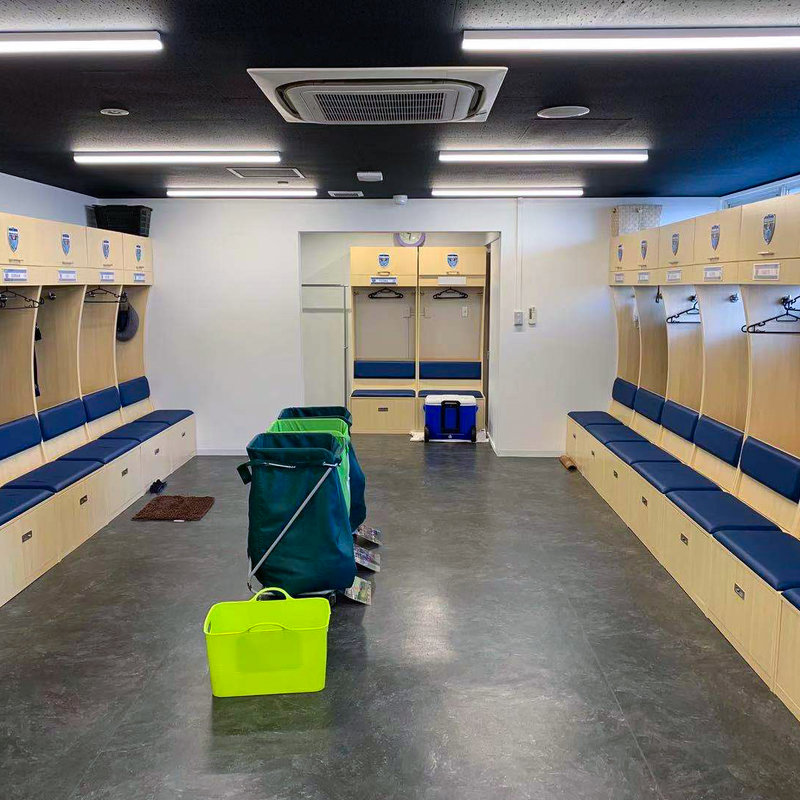
Compact laminate is a durable material made from thermofused layers and a resin-saturated core, known for its high moisture resistance and scratch resistance.
Compact laminate is suitable for athletic locker rooms due to its moisture resistance, durability in high-traffic settings, and low maintenance requirements, making it ideal for environments exposed to sweat, steam, and cleaning chemicals.
Compact laminate reduces maintenance costs by requiring minimal care, inhibiting bacterial growth, and avoiding repairs related to corrosion and varnish refinishing necessary for other materials like steel and plywood.

Since its establishment in 2001, Jialifu has been specializing in the design and manufacture of toilet cubicles, vanities, storage cabinets, IPS duct panels, and doors for commercial projects.
 EN
EN