
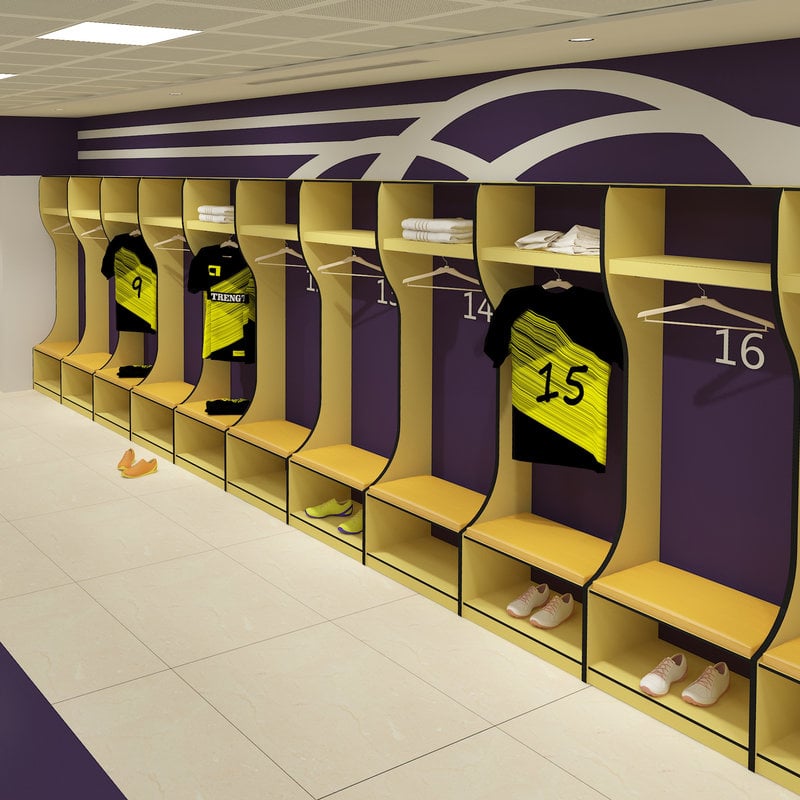
High-traffic sports facilities require lockers that withstand relentless daily abuse while maintaining functionality. Compact laminate sports lockers—specifically High-Pressure Laminate (HPL)—excel where alternatives fail due to three core advantages: superior moisture resistance, unmatched structural integrity, and hygienic resilience. Traditional steel lockers corrode in humid locker rooms, while MDF swells and delaminates when exposed to water. HPL achieves clinically low water absorption rates below 0.3%, preventing structural degradation. Its high-density core resists impacts and scratches that permanently dent steel or chip powder-coated finishes. Reinforced 18–25mm cores paired with load-rated hardware ensure decades of heavy use without sagging—unlike thinner MDF or particleboard. Finally, antimicrobial laminate finishes inhibit mold growth and simplify cleaning. While steel rusts and MDF warps, HPL maintains its appearance and strength, drastically reducing long-term replacement costs. For facilities prioritizing lifetime value and minimal maintenance, HPL delivers measurable operational advantages.
The critical performance metrics for athletic storage solutions directly combat facility challenges: chronic moisture exposure and relentless physical impact. Sports lockers must withstand flooded floors, equipment strikes, and humidity fluctuations without structural compromise.
A proprietary phenolic-resin core and sealed melamine surface create an impermeable barrier, limiting water absorption to ≤0.3% under EN 438-2:2016 testing—75% lower than untreated MDF. This microcrystalline structure prevents hydrolysis (fiber swelling) even when subjected to daily towel-draping, spilled beverages, or wet gear storage. Independent accelerated aging trials show no warping or delamination after 1,200 humidity cycles, making it ideal for pool decks and locker rooms.
While steel lockers dent permanently and corrode when coatings fail—increasing maintenance costs by 200% per Athletic Business Facility Report—compact laminate dissipates kinetic energy through its high-density core. Impact tests reveal:
This durability eliminates swelling-induced jamming—common in moisture-compromised MDF lockers—while offering 30% lighter weight than steel alternatives.
Sports lockers require exceptional durability to withstand constant use in athletic facilities. The 18–25mm compact laminate core provides superior structural integrity compared to thinner alternatives, absorbing impacts from equipment bags and accidental collisions without denting or cracking. Independent testing shows 25mm cores withstand 3× more force than standard 15mm particleboard. Reinforced steel rivets and anti-tamper fasteners complement this robustness, preventing hardware failure under repetitive stress. Unlike traditional locker materials, this engineered approach maintains dimensional stability through years of heavy use.
Critical stress points receive specialized reinforcement to prevent common failure modes. Full-length stainless steel hinges distribute weight evenly across the door, eliminating sagging that plagues standard pivot hinges after 10,000+ openings. Internally, welded steel plate backings anchor shelves capable of supporting 45 kg—equivalent to 6 loaded equipment bags. This exceeds typical facility demands by 40%, as documented in ASTM F1487 playground equipment standards. The integrated design ensures uniform load transfer from shelves to frame, preventing localized stress fractures that compromise cheaper lockers during peak usage periods.
Sports lockers in high-traffic athletic facilities require specialized hygienic features to combat persistent moisture and microbial growth. Beyond basic storage, modern designs incorporate ventilation systems that actively circulate air through perforated panels or louvered doors, preventing stagnant humidity where mold thrives. These engineering solutions work synergistically with non-porous compact laminate surfaces, which inherently resist bacterial adhesion.
Facilities implementing ventilated lockers with antimicrobial laminate surfaces report 68% fewer mold-related issues compared to standard units. The continuous airflow disrupts spore colonization cycles, while silver-ion infused laminate finishes create an inhospitable surface for pathogens. This dual-action approach is particularly valuable in poolside environments and humid climates where traditional materials fail. Maintenance teams benefit from wipe-clean surfaces that eliminate deep cleaning chemicals, reducing operational costs by up to 30% annually.
HPL lockers are preferred due to their superior moisture resistance, high structural integrity, and hygienic finishes that prevent mold growth.
A phenolic-resin core sealed with melamine limits water absorption to ≤0.3%, preventing swelling and degradation.
Yes, with reinforced cores and load-rated hardware, compact laminate lockers are engineered to withstand decades of heavy and repetitive use in demanding environments.
Yes, antimicrobial finishes and ventilated designs actively combat mold and bacterial colonization.
Unlike steel that corrodes and MDF that swells, compact laminate maintains its structural integrity and reduces maintenance costs over time.

Since its establishment in 2001, Jialifu has been specializing in the design and manufacture of toilet cubicles, vanities, storage cabinets, IPS duct panels, and doors for commercial projects.
 EN
EN